
PRP Therapy
Advanced Platelet-Rich Plasma (PRP) Injections at St. Johns Podiatry & Wound Care Specialists
If chronic foot pain, ankle injuries, tendon damage, or arthritis are keeping you from living an active lifestyle, Platelet-Rich Plasma (PRP) therapy may offer a minimally invasive solution that helps your body heal naturally. At St. Johns Podiatry & Wound Care Specialists, we provide advanced regenerative medicine treatments using PRP injections to help reduce pain, accelerate healing, and potentially delay or even avoid surgery for many common lower extremity conditions.
Whether you’re an athlete recovering from an injury or someone struggling with long-term foot or ankle pain, our board-certified podiatrists develop personalized treatment plans to restore mobility and improve your quality of life.
What is Platelet-Rich Plasma (PRP)?
Platelet-Rich Plasma (PRP) is an innovative regenerative medicine treatment created using a small sample of your own blood.
After your blood is drawn, it is processed in a specialized centrifuge that separates and concentrates platelets containing powerful growth factors responsible for tissue repair.
These concentrated platelets are then carefully injected into the injured tissue where they help stimulate the body’s natural healing response.
Unlike steroid injections that primarily mask inflammation, PRP is designed to encourage the body to repair damaged tissue from within.
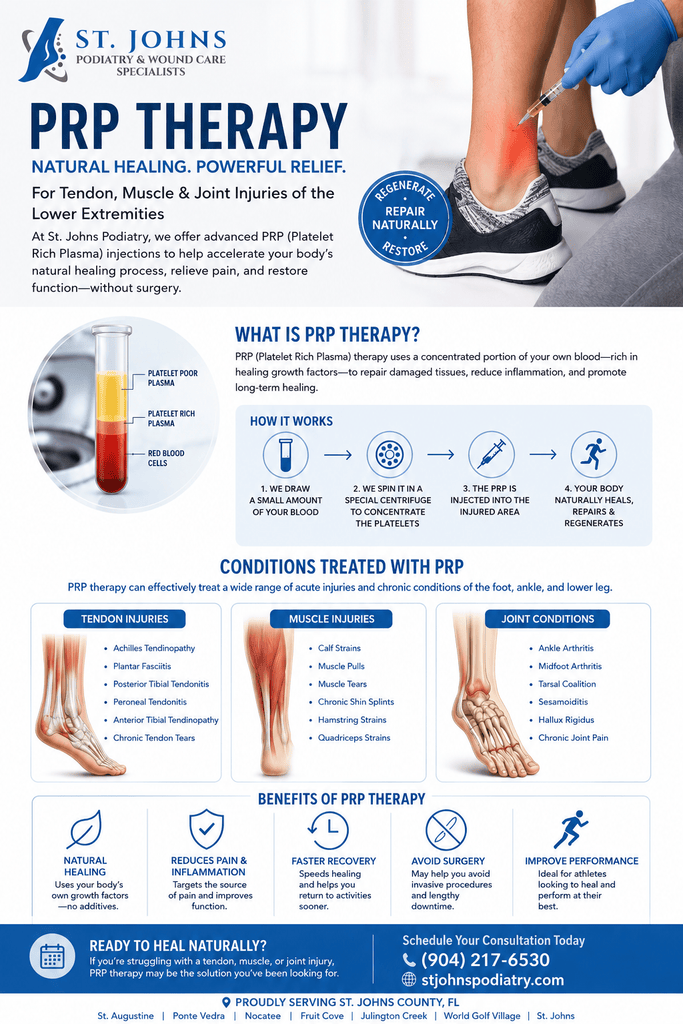
How PRP Therapy Works
Step 1
A small blood sample is collected during your office visit.
Step 2
The sample is processed to isolate a high concentration of healing platelets.
Step 3
Using advanced injection techniques, PRP is placed precisely into the injured tendon, ligament, muscle, fascia, or joint.
Step 4
Growth factors stimulate tissue regeneration, reduce inflammation, improve blood flow, and encourage long-term healing.
Most patients return home immediately after treatment with little downtime.
Conditions That May Benefit from PRP Therapy
PRP has become one of the most researched regenerative medicine treatments for musculoskeletal injuries and chronic tendon disorders.
Heel Pain & Plantar Fasciitis
Patients suffering from chronic plantar fasciitis that has failed:
- Physical therapy
- Orthotics
- Cortisone injections
- Stretching programs
may experience significant improvement with PRP therapy by promoting healing within the damaged plantar fascia.
Achilles Tendon Injuries
PRP is commonly used to treat:
- Achilles tendinitis
- Achilles tendinosis
- Partial Achilles tears
- Chronic insertional Achilles pain
Helping reduce inflammation while stimulating tendon repair.
Posterior Tibial Tendon Dysfunction (PTTD)
One of the leading causes of adult-acquired flatfoot, PTTD often responds well to regenerative treatments before severe degeneration occurs.
PRP may help:
- Strengthen damaged tendon fibers
- Reduce inflammation
- Improve walking comfort
- Slow progression toward surgery
Peroneal Tendon Injuries
Ideal for:
- Chronic ankle instability
- Peroneal tendonitis
- Small tendon tears
- Overuse injuries
especially in runners and active individuals.
Ankle Sprains & Ligament Injuries
Repeated ankle sprains often leave ligaments weakened.
PRP can help encourage healing of:
- ATFL injuries
- CFL injuries
- Chronic ankle instability
- Persistent ankle pain after sprains
Arthritis of the Foot & Ankle
Patients with mild to moderate arthritis frequently seek alternatives to repeated steroid injections.
PRP may help reduce symptoms associated with:
- Ankle arthritis
- Midfoot arthritis
- Great toe arthritis (Hallux Rigidus)
- First MTP joint arthritis
- Subtalar arthritis
Tendon Tears
PRP may benefit patients with:
- Chronic tendon degeneration
- Partial tendon tears
- Overuse injuries
- Degenerative tendinopathy
Muscle Injuries
Athletes frequently use PRP to recover from:
- Calf strains
- Muscle tears
- Hamstring injuries
- Chronic muscle inflammation
Sesamoiditis
Pain beneath the ball of the foot caused by inflammation around the sesamoid bones may improve with regenerative medicine when conservative treatment has failed.
Chronic Foot Pain
Many patients who have experienced months or years of persistent pain despite traditional treatment may be excellent candidates for PRP.
Who is an Ideal Candidate for PRP?
You may benefit from PRP therapy if you:
- Have chronic pain lasting longer than 3 months
- Have failed physical therapy
- Have failed orthotics or bracing
- Want to avoid surgery if possible
- Wish to avoid repeated cortisone injections
- Have tendon, ligament, muscle, or joint injuries
- Want a treatment that uses your body’s natural healing ability
Benefits of PRP Therapy at St. Johns Podiatry
Patients throughout St. Augustine, St. Johns County, and Northeast Florida choose PRP because it offers numerous advantages:
Natural Healing
Uses your own platelets without synthetic medications.
Minimally Invasive
Performed comfortably in the office with no hospitalization.
Reduced Inflammation
Targets damaged tissue rather than simply masking pain.
Accelerated Recovery
May shorten recovery times for many tendon and muscle injuries.
Improved Function
Helps patients return to walking, exercise, sports, and daily activities.
Lower Risk
Since PRP comes from your own blood, allergic reactions are extremely uncommon.
Potential to Delay or Avoid Surgery
For properly selected patients, PRP may reduce symptoms enough to postpone or eliminate the need for surgery.
PRP vs. Cortisone Injections
| PRP Therapy | Cortisone Injection |
|---|---|
| Uses your own blood | Synthetic medication |
| Promotes tissue healing | Primarily reduces inflammation |
| May improve long-term healing | Often temporary pain relief |
| Supports tendon repair | Repeated use may weaken tendons |
| Natural regenerative treatment | Anti-inflammatory treatment |
What to Expect During Your Appointment
Your visit begins with a comprehensive foot and ankle evaluation by one of our experienced podiatrists.
Depending on your condition, your treatment may include:
- Digital X-rays
- Diagnostic ultrasound
- MRI review
- Gait analysis
- Biomechanical evaluation
If PRP is appropriate, your injection is typically completed during the same visit or shortly thereafter.
Most procedures take approximately 30–45 minutes.
Frequently Asked Questions
Does PRP hurt?
Most patients experience only mild discomfort during the injection. Local anesthetic may be used depending on the treatment area.
How many injections will I need?
Many patients improve after a single treatment, while others with more advanced conditions may benefit from a series of injections.
How long before I notice improvement?
Many patients begin noticing improvement within 4–8 weeks, with healing continuing over several months as tissues regenerate.
Is PRP covered by insurance?
PRP is often considered an elective regenerative medicine treatment and may not be covered by insurance. Our office will discuss all costs before treatment.
Why Choose PRP Therapy at St. Johns Podiatry & Wound Care Specialists?
At St. Johns Podiatry & Wound Care Specialists, we combine advanced regenerative medicine with comprehensive foot and ankle expertise.
Patients throughout:
- St. Augustine
- St. Johns
- Ponte Vedra
- Nocatee
- World Golf Village
- Julington Creek
- Fruit Cove
- Hastings
- Palm Valley
- Vilano Beach
- Elkton
trust our team for personalized, evidence-based care focused on helping patients remain active while avoiding unnecessary surgery whenever possible.
Our goal is always to exhaust the most effective conservative treatment options before recommending surgical intervention.
Schedule Your PRP Consultation Today
If chronic heel pain, tendon injuries, arthritis, or foot and ankle pain are limiting your lifestyle, Platelet-Rich Plasma therapy may be the next step toward lasting relief.
Contact St. Johns Podiatry & Wound Care Specialists today to schedule a comprehensive evaluation and find out whether PRP therapy is right for you.
Call: (904) 217-6530